
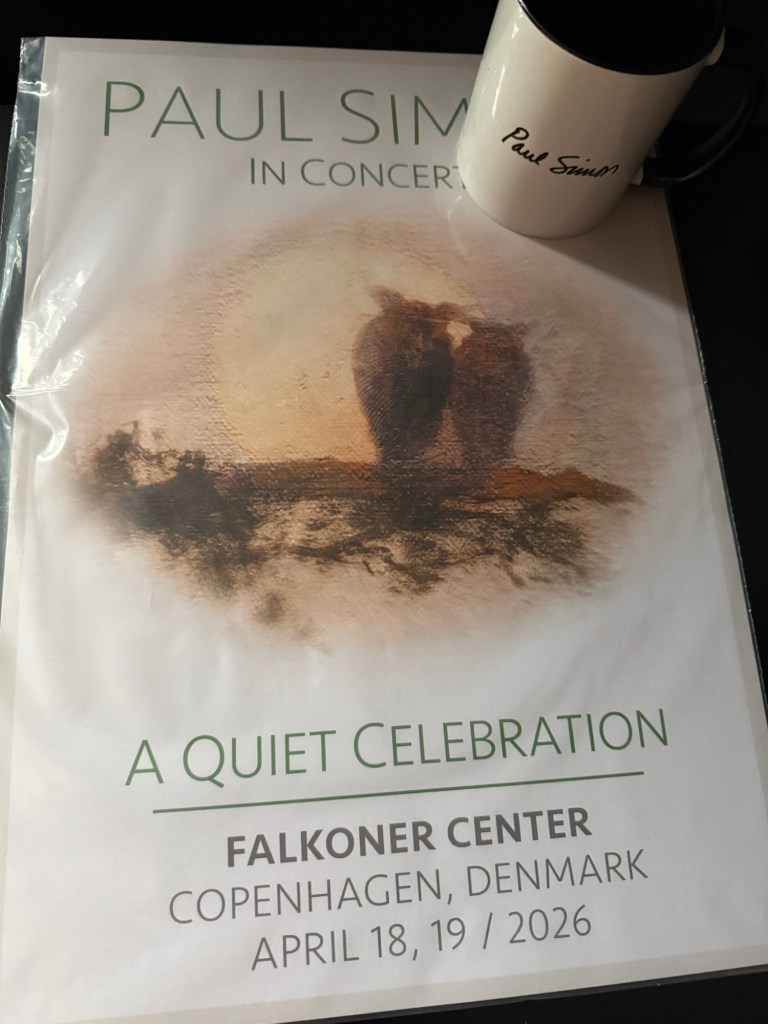
Paul Simon – The Quiet Celebration Tour: Concerts at Falkoner in Copenhagen, April 18 and 19, 2026.
(Translated with help of AI. The review is mainly based on the April 18 concert, with additional observations from April 19. On the 18th we sat in the sixth row; on the 19th in the 12th row, a bit farther back but with a better overview and perhaps better sound. Two fairly similar concerts with the same setlist, but with the chance to take in and remember even more.)
A sense of ceremony
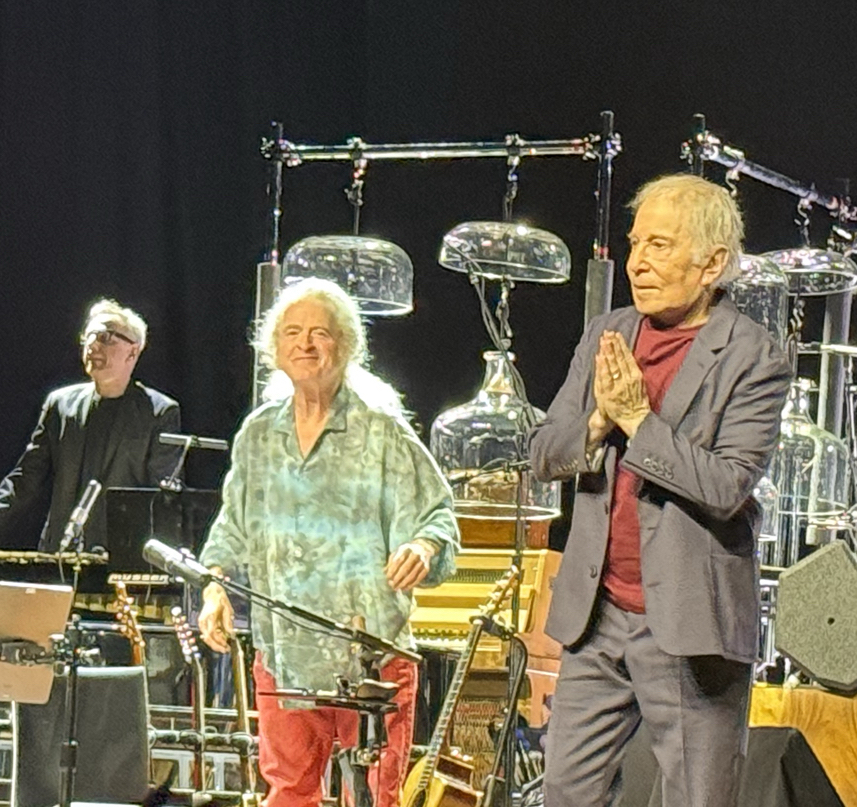
When Paul first walks onto the stage this Saturday evening, the entire hall rises to its feet and applauds. Paul lets us go on for several minutes. He is clearly moved and shows it. Perhaps I even glimpse a small tear on his cheek. We are 2,000 people in the legendary Falkoner Hall in Copenhagen. The audience is honoring him for what he has meant to us. When the concert ends, we celebrate him for yet another great experience—though also a different kind of experience than he has given us before.
“I could hardly breathe.” Paul Simon and his band have just performed his entire latest work, Seven Psalms, when the outburst comes from my wife, who is almost as big a fan as I am. The audience is completely silent during the performance. Not a single mobile phone in sight. The delivery is relaxed and intense at the same time. Toward the end of this set, Paul’s wife, Edie Brickell, joins him. Dressed in white, she looks like an angel, sings like an angel. “The Sacred Heart.”
Seven Psalms takes us into a landscape somewhere between dream and reality. Paul Simon has said that Seven Psalms is a discussion he has with himself about faith or the absence of it. And I would add: also in light of the fact that his own life must necessarily be approaching its end. He sings about the little boy he once was, the touring musician. They are gone. What remains is an old man facing his mortality, wondering what comes next. The musicians and Paul gently lift the parts of the work through variations in intensity, offering subtle nuances. No individual musician takes the spotlight in this part of the concert. Naturally, Seven Psalms consists of seven parts. Between them, the audience hesitates. Should we applaud? Some clap lightly, others refrain so as not to break the mood. The atmosphere cannot be broken by a little hesitation—it simply reflects the connection between audience and musicians on this Saturday evening in Copenhagen. On Sunday, the audience is more restrained, with fewer attempts at applause between sections. Paul still receives a standing ovation, but shorter and more subdued.
On Sunday, I pay more attention to the man playing various types of bells. Mick Rossi is crucial to the soundscape in this part of the concert, and although not very visible, he is constantly moving around the stage creating the distinctive tones that define Seven Psalms.
I read a comment on Facebook saying that someone liked ten Paul Simon albums better than Seven Psalms. Fair enough—but there is no album by any artist I would rather have heard performed in full these days.
A bit of history
In the summer of 2018, Paul Simon gave a top-rated concert at Oslo Spektrum. He was on his farewell tour. I had never seen him better—except perhaps at the same venue two years earlier. Going forward, he was to be “Homeward Bound,” playing only occasional charity concerts. In 2023, he released what is, so far, his final album: the understated, meditative work Seven Psalms, designed to be performed in its entirety. He wanted to take it on the road—but there was a problem. His hearing in one ear had been seriously impaired. A lifelong perfectionist, Simon was held back. Eventually, he resolved the issue, and in 2025 he launched his Quiet Celebration tour in the U.S. The name suggested less exuberance and fewer uninhibited rhythmic outbursts than before—but still a celebration. A celebration of life and music.
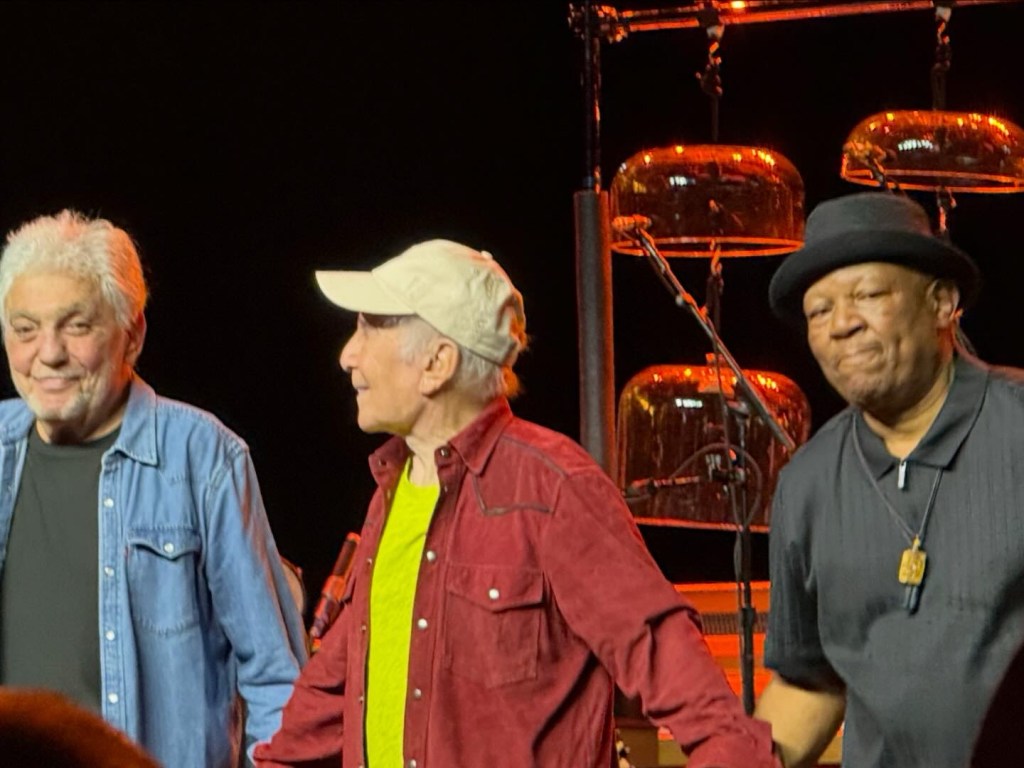
I had my doubts whether the now 84-year-old man would come to Europe, but when concerts were announced, my wife and I didn’t hesitate. Two shows in Copenhagen—and the most expensive tickets we’ve ever bought. We don’t debate that; it’s simply a priority for a financially comfortable middle-class couple from Norway.
I think back to my first Paul Simon concert. It was 1991; I was 21. I had been looking forward to it for a long time. On the day itself, I was restless—walking around Oslo, stopping by Deichman Library. I hardly need to say that I got goosebumps when he appeared on stage and began to play. Back then, he seemed old to me—49 years. “So fit and energetic for someone that old,” I thought. Well, now I am seven years older than he was then.
In 2018, Paul Simon’s warm, beautiful voice was still largely intact. We knew beforehand that it had aged significantly since then. But having seen him six times before (my wife five), we were more than ready for a different kind of experience. A reviewer in Denmark’s Ekstra Bladet thought someone should have stopped him. Most others disagree. Paul Simon is more than the velvety voice—he is a songwriter and arranger who keeps taking his art into new places and new phases of life.
After the intermission
Back to the concert. Paul and his roughly 11–12-piece ensemble return after the break to perform both well-known songs and ones he has always enjoyed playing live—many of which I’ve heard at earlier concerts. Though Paul has changed into a more rock-oriented outfit and the tempo is often slightly higher than during Seven Psalms, everything is presented in a way that suits the aging artist. He sometimes stands now, but both he and the band remain seated most of the time. Where earlier concerts might erupt in rhythmic explosions, Paul now emphasizes subtle, often understated variations, giving different parts of the band room to shine at different moments.
The chamber ensemble—already prominent during Seven Psalms—gets significant space in songs like the ever-beautiful “René and Georgette Magritte With Their Dog After the War” and a stunning “The Late Great Johnny Ace.” Paul shares brief anecdotes about the songs’ origins: the former inspired by a title he found in a book about the artist couple, the latter about singer Johnny Ace, who accidentally shot himself. The song also references John F. Kennedy and John Lennon, both killed by gunfire. In the closing section, with a composition by Philip Glass, the chamber players create magic while Paul carefully sips water so as not to disturb the moment. A lovely flute performance by Nancy Stagnitta.
We get three songs from my favorite Paul Simon album, Hearts and Bones (1983). Alongside the two already mentioned, he performs “Train in the Distance,” and we sense he has lived the words: “Negotiations and love songs are often mistaken for one and the same.” These were songs I was completely hooked on at 13–14 years old. A fantastic closing horn solo—Andy Snitzer, I believe.
World music
Paul Simon’s music knows no boundaries. We’re taken to Graceland (1986) with the title track and “Under African Skies.” Bakithi Kumalo, the only remaining member of the original Graceland band, shines on bass and with playful vocal acrobatics. “So lively and fun to watch,” my wife says. Edie Brickell joins Paul in a duet, and we hear more of her distinctive voice. Paul also says a few words about the late Joseph Shabalala, founder of Ladysmith Black Mambazo.
More world music follows with “Spirit Voices” and “Cool, Cool River” from The Rhythm of the Saints (1990). Beautiful versions full of interaction between Paul and the musicians. “Cool, Cool River” ends with a powerful piano solo from Mick Rossi, having traveled through chamber music, jazz, and world music.
Toward the end
Guitarists Mark Stewart and Gyan Riley handle much of the guitar work, while Paul still proves he fully masters the instrument himself. In “Rewrite,” they shine. Later, legendary drummer Steve Gadd is introduced—slightly out of sequence—and finally unleashed on “Fifty Ways to Leave Your Lover,” to great effect.
There are many highlights. “Something So Right” is heartbreakingly beautiful. “Slip Slidin’ Away” becomes a new high point in a concert full of them. Even songs I thought I was tired of—like “Me and Julio Down by the Schoolyard” and “Homeward Bound”—feel renewed. The 84-year-old artist reshapes them with the perspective of age. Limitations become possibilities.
The fighter still remains
The penultimate encore is a quiet singalong of “The Boxer.” After the line “I am leaving, I am leaving, but the fighter still remains,” the band takes its leave. I get goosebumps again—because that’s exactly what he’s doing, and what we all must do: not give up. Regardless of what critics may say.
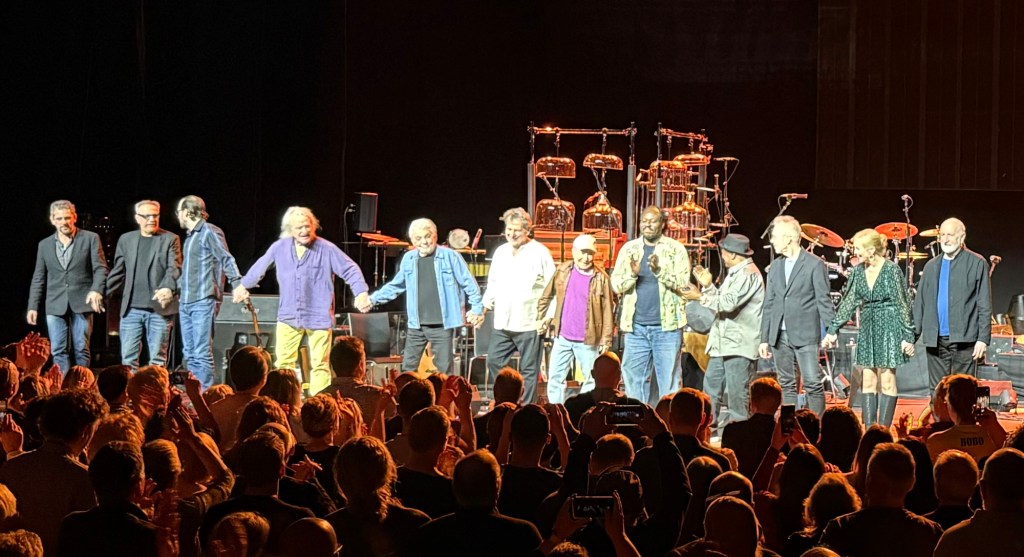
Paul remains alone on stage for “The Sound of Silence.” The evening ends. He must eventually leave us—but not before taking his time to receive the audience’s tribute, and to thank them in return.
These were the most intimate Paul Simon concerts I have experienced. A unique encounter with an artist who never seems to stop searching for new expressions—this time through a delicate interplay between chamber music and world music. Tearful, goosebump-inducing, moving. Beautiful.


Hørte også Paul Simon i Oslo i 1991. Og igjen i Spektrum i 2004 ( m Garfunkel + Everly Br.) Og altså i 2018 – for 3. og siste gang. Synd jeg – pga sykdom – ikke fikk med meg København nå denne uken. Du har skrevet en god omtale av denne siste konserten.
LikerLiker
Takk for det! Tre strålende konserter du fikk med deg!
LikerLiker